Septic Tank Backed Up? What to Do Right Now
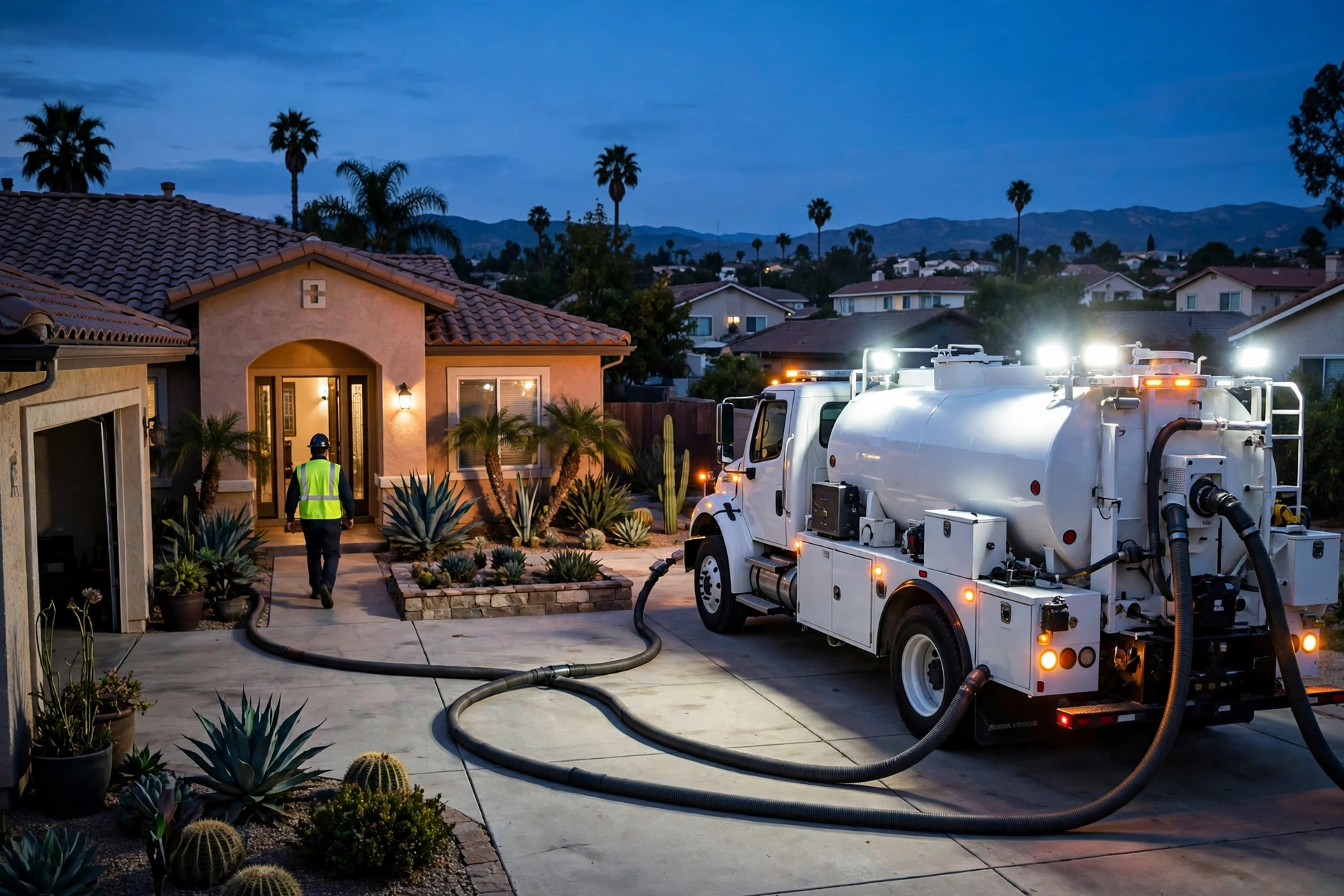
Sewage coming up through a shower, a bathtub, or a floor drain is the one septic problem that cannot wait until Monday. It is a health risk, and it gets worse with every gallon of water that goes down a drain. The first thirty minutes are simple, and doing the right things in the right order keeps a bad morning from becoming a ruined floor and a much bigger bill.
Stop the water, keep people away from the sewage, and call for emergency septic service. Then read the rest: how to tell a backup from a clogged drain, what never to do, what usually caused it, and what happens after the technician arrives.
Stop the water: the first 5 minutes
When sewage comes up, stop every source of water in the house. No flushing, no showers, no laundry, no dishwasher, no running taps. Every gallon that goes down a drain has to go somewhere, and right now somewhere is your floor. Tell everyone in the house to stop using water.
Next, keep everyone away from the sewage, especially children and pets — it carries bacteria and viruses. Do not walk through it in bare feet, and do not try to mop it up yet. Then call for emergency septic service at (805) 307-3409 and describe what you see: which drain, how much, and whether it is still rising.
Backup vs. clogged drain: how to tell
Not every backup is a septic backup, and the difference decides who you call. A single slow or overflowing fixture — one toilet, one sink — is usually a clogged drain, and a plunger or a drain snake may fix it. A septic backup shows up in more than one place at once, and at the lowest drain in the house first: the shower or bathtub on the ground floor, or a floor drain. If flushing the upstairs toilet makes the downstairs shower gurgle or rise, the problem is downstream of the fixtures — in the tank or the line to it.
The other tell is the smell and the look: septic backup brings dark water, solids, and a smell you cannot mistake, while a clogged sink drain brings grey water. If more than one fixture is affected, or the lowest drain is overflowing, call a septic company, not a drain cleaner.
What NOT to do
Do not keep flushing or running water to test whether it has cleared — each test makes it worse. Do not pour drain cleaner down the drain: it will not clear a backup, and it kills the bacteria the tank needs to work. Do not use a plunger or a snake on a backup affecting several fixtures.
Most important of all: do not open the septic tank, and never climb into one. A septic tank produces methane and hydrogen sulfide, gases that are colorless and, at the concentrations inside a tank, can knock a person unconscious in a single breath. Hydrogen sulfide is deadly, methane is explosive, and people have died leaning into a tank to look. Never open a tank without proper equipment, and never enter one for any reason. Leave the tank to the technician, who has the equipment to open it safely.
What caused it: the 4 usual causes
Most backups come down to four causes. The first is a tank that is simply full — it has not been pumped in years, the sludge layer has reached the outlet, and solids are blocking the flow. The second is a clogged outlet, filter or baffle: the tank has room, but the exit is blocked. The third is a failed pump, in homes that have one: the pump or its float switch stops working and the chamber fills.
The fourth is a drainfield that can no longer take water: the soil is clogged, the field is saturated, or tree roots have grown into the pipes. The technician will work out which of the four it is, because the fix is different for each — a pump-out, a filter or baffle repair, a pump replacement, or drainfield work.
When to call emergency service
Call for emergency septic service the moment sewage is backing up into the house, overflowing from the tank, or surfacing in the yard. Do not wait to see whether it clears on its own — it will not, and every hour of water use adds to the mess. If the septic alarm is sounding and water is still being used, call as well: the alarm means the tank is too full, and the backup is coming.
When you call, say sewage is backing up, which drains are affected, and whether the water is still rising. Stop running water while you wait and keep the area closed off. Do not clean the sewage until the technician has seen it — the mess shows where the backup is coming from.
After the backup: pumping and inspection
Once the backup is stopped, the technician pumps the tank and inspects it — the baffles, the filter, the inlet and outlet, and the drainfield area — to find what caused it and whether anything else is damaged. That inspection is part of the visit, and it is what keeps the backup from happening again next month. A backup caused by a full tank is fixed by the pump-out; one caused by a cracked baffle or a clogged filter needs that part fixed too.
After the visit, the cleanup is yours: contaminated floors need proper cleaning and disinfection, and soft furnishings that soaked up sewage usually have to go. Set the next pump-out date before the technician leaves, and keep to it.
Get a free estimate
Reading is a good start — a visit is better. Tell us what is happening with your septic system and we will tell you what it needs and what it costs. Free, no obligation.
Related service: Emergency Septic Service
Request a Free Estimate
Tell us what is happening — we reply with next steps and a free estimate.